
Urgent Isn't the Same as Important — and the Confusion Is Costing You
OPERATIONAL EXCELLENCEPROCESS IMPROVEMENTLEADERSHIP
7/11/2026
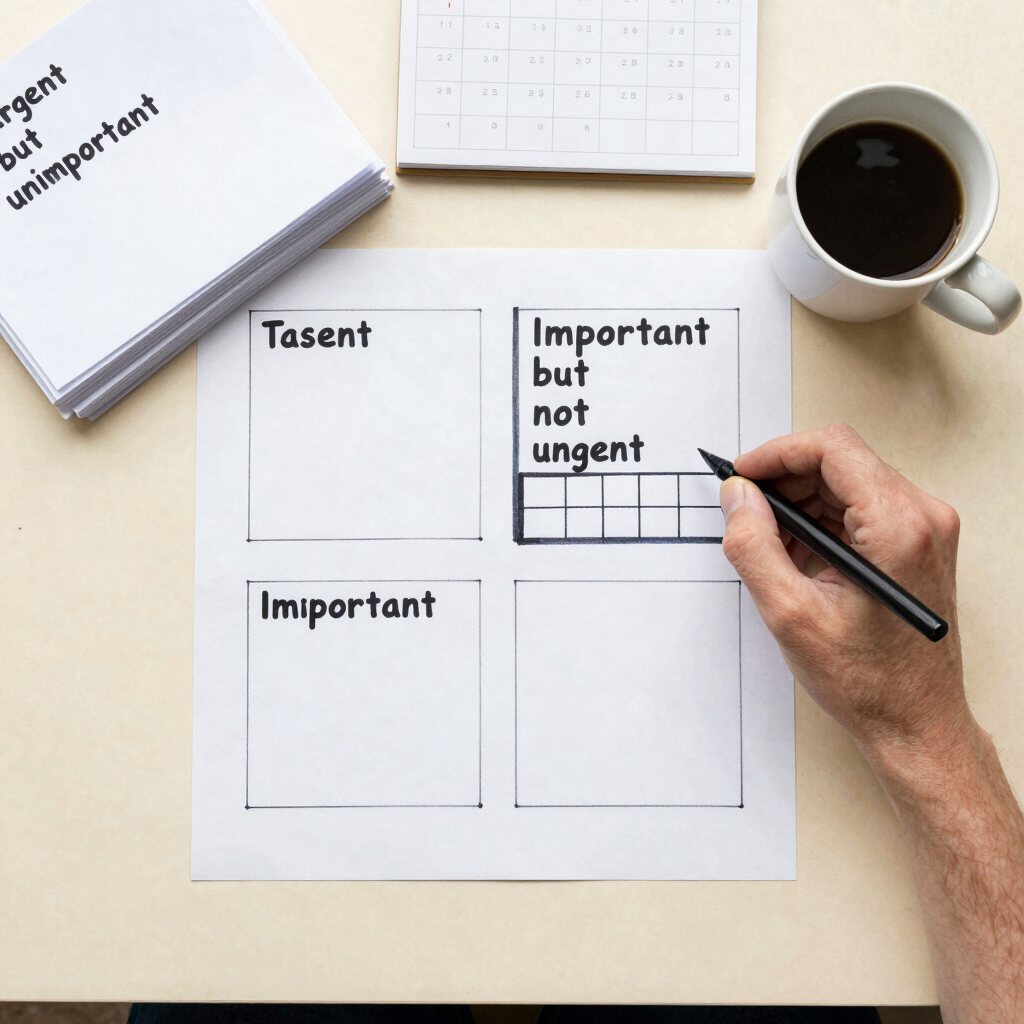
Ask a busy business owner or leader how their day went, and the answer is often some version of "I was slammed, but I'm not sure I actually got anything done." This is one of the most common and corrosive experiences in modern work: a day full of activity, responsiveness, and effort that nonetheless failed to move anything that matters forward. The person was busy. The business didn't advance.
The research reveals the mechanism behind this experience. Microsoft's analysis of over 31,000 users found that the average employee spends 57% of their time communicating — in meetings, email, and chat — and only 43% actually creating or producing. And a 2024 study found that 25% of people have no prioritization system at all: they simply deal with whatever feels most important in the moment. This is the definition of firefighting — reacting to whatever is loudest, while the important-but-not-urgent work that actually builds the business gets swept aside.
57% of the average employee's time spent communicating rather than producing — leaving only 43% for the work that actually creates value
Microsoft 365 Analysis of 31,000+ Users
The core confusion driving this pattern is the conflation of two things that feel identical in the moment but are fundamentally different: urgency and importance. Urgent tasks demand immediate attention — the ringing phone, the flagged email, the request that just landed. Important tasks contribute to meaningful long-term goals — strategy, relationship building, developing people, improving processes. The trap is that urgency is loud and importance is quiet, so without a deliberate system, the urgent perpetually crowds out the important.
The Eisenhower Matrix: A 70-Year-Old Answer That Still Works
The most durable framework for resolving this confusion originated with Dwight D. Eisenhower and was later formalized by Stephen Covey into the four-quadrant model now widely known as the Eisenhower Matrix. It sorts every task along two dimensions — urgent or not, important or not — producing four quadrants, each with a clear action.
1 Urgent and important — Do it now
Genuine crises, pressing deadlines, and problems that demand immediate attention and genuinely matter. These get tackled first. The trap is that for many overwhelmed leaders, this quadrant expands to consume the entire day — because the absence of attention to quadrant two keeps generating quadrant-one emergencies.
2 Important but not urgent — Schedule it
This is the most important quadrant, and the one that determines whether a business grows or stagnates. Strategic planning (Post 21), relationship building (Post 10), developing people (Post 18), improving processes (Post 29) — none of it is urgent, so without deliberate scheduling and protection, it never happens. The research is clear: leaders who protect time for quadrant two prevent those tasks from becoming quadrant-one crises later. This is where the 90-day execution discipline of this series lives.
3 Urgent but not important — Delegate it
Tasks that demand immediate attention but don't genuinely require you or advance meaningful goals — many interruptions, requests others consider urgent, routine matters that feel pressing. These are the prime candidates for the delegation discipline of Post 26. Every quadrant-three task a leader personally handles is time stolen from quadrant two. The question to ask: does this actually require me, or does it just feel urgent?
4 Neither urgent nor important — Eliminate it
Time-wasters that contribute nothing to goals or responsibilities — unnecessary meetings (Post 12), duplicate updates, low-value busywork. The research found that 10% of "less meaningful work" was pure duplication — over four hours per week wasted on unnecessary repetition. This quadrant should be ruthlessly minimized. The time it frees is the raw material for the important work that actually matters.
Time management isn't about squeezing more into your day — it's about protecting space for what matters. The urgent is loud; the important is quiet. Without a system, the loud always wins.
— KaryaKeeper Time Management Research, 2025
From Framework to Practice
The Eisenhower Matrix is simple to understand and difficult to live — because the pull of the urgent is relentless. The research points to a set of practices that convert the framework from a concept into an operating discipline.
Time-blocking for quadrant two. The single most effective practice is protecting dedicated, uninterrupted blocks — 60 to 90 minutes — for important-but-not-urgent work, treated with the same non-negotiable status as a client meeting. As the deep-work research and the meeting-culture findings of Post 12 established, sustained focus blocks are where the highest-value work actually happens, and they must be deliberately defended against the fragmenting pull of communication.
The two-minute rule and meeting triage. If something takes less than two minutes, do it immediately rather than letting it accumulate. If a meeting has no agenda or clear purpose, decline it or request an async alternative — the meeting discipline of Post 12 applied at the individual level. These small filters prevent quadrant-three and quadrant-four items from silently consuming the day.
A real prioritization system — any system. The finding that 25% of people have no system at all points to the lowest-hanging fruit: simply having a deliberate way to decide what to work on, rather than reacting to whatever feels most pressing, is transformative. The research found that people using the Eisenhower Matrix felt in control of their workload at least four days a week — a dramatic improvement over the reactive firefighting that characterizes an unmanaged workday.
The connection to everything else
Time management is not a personal-productivity footnote to this series — it is the daily mechanism that makes everything else possible. The strategic planning, the delegation, the process improvement, the relationship building, the leadership development: all of it lives in quadrant two, and none of it happens unless a leader deliberately protects the time for it against the endless pull of the urgent. Protecting that time is the discipline on which all the others depend.
Contact
Let's improve your business together.
contact@rmscsolutions.com
© 2026 All rights reserved.
Contact
+1 647-576-7000