The Science of Bottlenecks: Why Your System Is Only as Strong as Its Weakest Link
STRATEGY & EXECUTION
4/11/2026
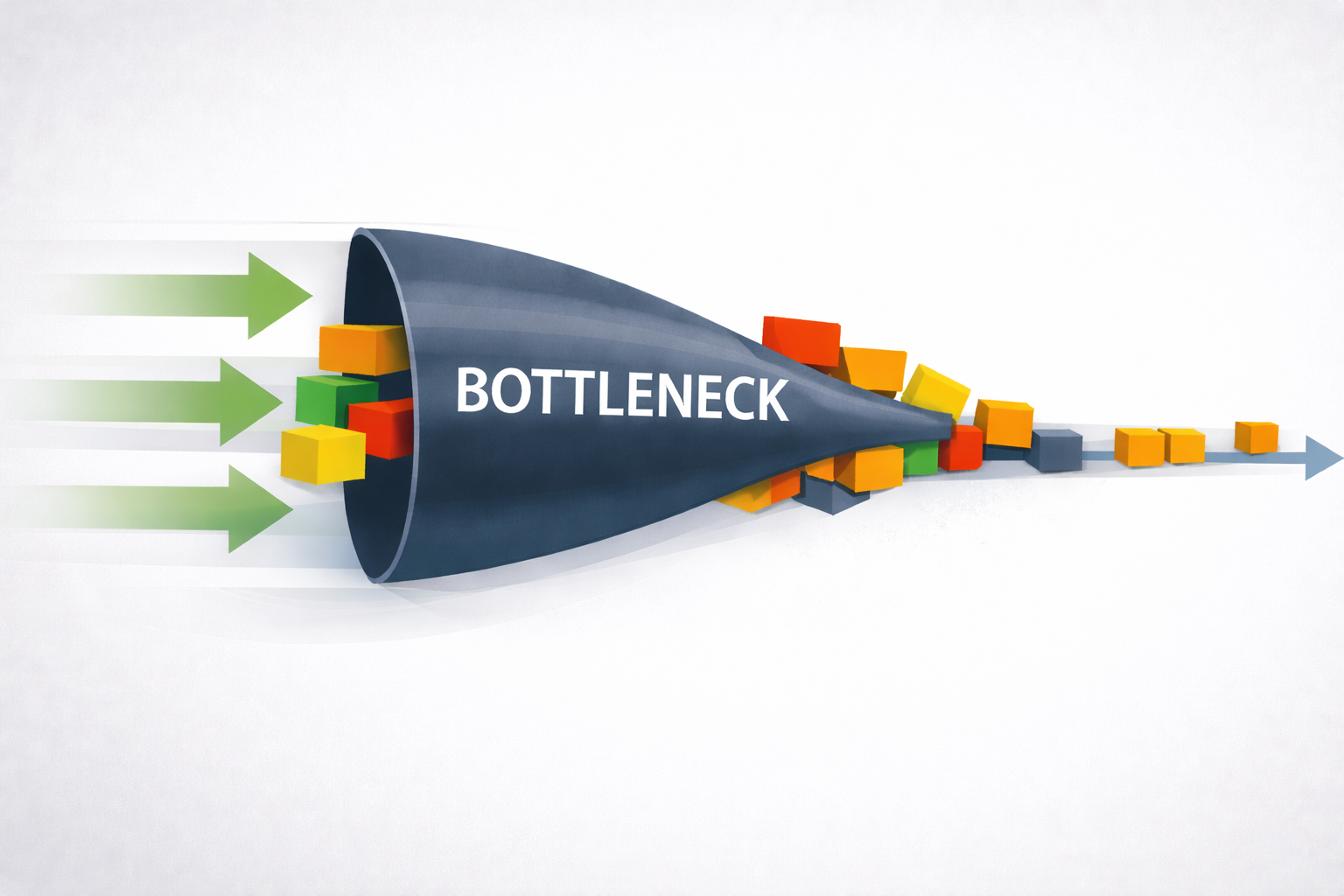
Every business has a bottleneck.
The problem is—most don’t know where it is.
The science behind bottlenecks comes from the Theory of Constraints, developed by Eliyahu M. Goldratt.
The principle is simple:
A system’s output is limited by its weakest constraint.
Not its busiest team. Not its most complex process. Its constraint.
What Science Tells Us
In systems theory, improving non-constraints does not significantly increase overall output. In fact, it often creates more work-in-progress (WIP), increasing delays and inefficiencies.
Think of it like traffic.
If one lane is closed on a highway, widening other lanes doesn’t fix the congestion. You have to address the bottleneck.
Where Bottlenecks Hide in Organizations
Approval layers slowing decisions
Overloaded team members
Inefficient software systems
Poor handoffs between departments
The challenge is that bottlenecks often don’t look like bottlenecks. They look like “busy teams” or “complex work.”
How to Identify a Bottleneck
Look for:
Work piling up in one area
Long wait times between steps
Teams constantly “catching up”
High utilization with low output
What High-Performing Organizations Do
They don’t try to optimize everything. They focus on flow.
Here’s how:
1. Identify the Constraint
Map your process and find where work slows down.
2. Exploit the Constraint
Ensure the bottleneck is always working on the highest-value tasks.
3. Subordinate Everything Else
Align all other processes to support the constraint.
4. Elevate the Constraint
Add capacity only when necessary.
This structured approach is what separates reactive organizations from high-performing ones.
The Counterintuitive Truth
Improving efficiency everywhere can actually make things worse.
Why?
Because it increases input into the bottleneck, creating more congestion.
The Bottom Line
Operational performance isn’t about doing more—it’s about improving flow where it matters most.
Fix the constraint, and the entire system improves.
Contact
Let's improve your business together.
contact@rmscsolutions.com
© 2026 All rights reserved.
Contact
+1 647-576-7000