
The January Surprise: How One Owner Stopped Being Ambushed by His Own Business
FINANCE
7/18/2026
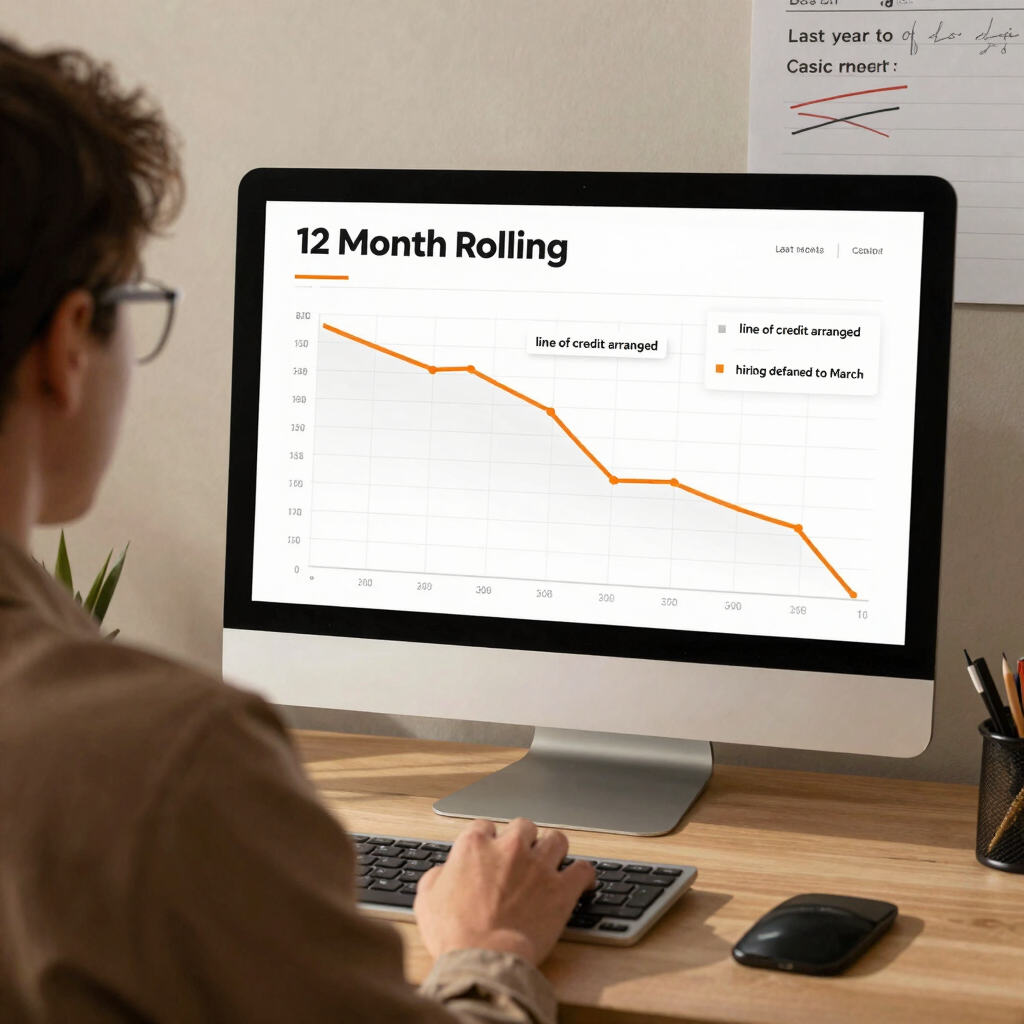
Sam owned a landscaping and property-services company in its ninth year — thirty staff in peak season, a good reputation, real profits. And every January, without fail, the business nearly gave him a heart attack. Revenue thinned as contracts paused for winter. Payroll, insurance, and equipment leases did not pause with them. Cash tightened, Sam panicked, and the same emergency playbook ran: delay a supplier, chase overdue invoices in a frantic week, sometimes draw on a personal credit line at painful rates. By April, cash was flush again and the whole episode was forgotten — until the next January arrived, as it always did, like a total surprise.
The absurdity finally landed in year nine, when his newest hire — a young operations coordinator — asked an innocent question in a December meeting: "This slow period... does it happen every year?" Sam started to answer and stopped. It happened every year. It had happened eight times. It was, in fact, the single most predictable event in the business's calendar. And the business it happened to was run, financially, as if the future were unknowable — an annual budget written in optimistic November ink, filed away, and never consulted again.
Sam's situation is the norm, not the exception. As established in Post 13 of this series, 82% of small business failures trace to cash flow problems — and much of that cash flow pain is not unpredictable at all. It is predictable events striking businesses that never built the machinery to look ahead.
61% of companies that adjusted forecasts quarterly outperformed those that stuck to static annual budgets — the case for treating the financial plan as a living instrument, not an annual ritual
FP&A Trends Report, 2025
The Problem Wasn't Information. It Was the Instrument.
Sam had eight years of monthly financials sitting in his accounting software — a dataset that described his business's seasonal rhythm with near-perfect clarity. Revenue fell to roughly 55% of summer levels each December through February. Receivables slowed by about two weeks in the same window. Equipment costs spiked every spring. The pattern was as regular as the seasons that caused it. What Sam lacked was not data but an instrument that turned the data into foresight: something that looked forward instead of only backward.
The research validates both the diagnosis and the fix. The Institute of Business Forecasting found that companies leveraging at least three years of monthly historical data improve forecasting accuracy by up to 20% — Sam had eight. And the instrument the modern research consistently points to is the rolling forecast: a forward view, typically twelve months, where each month that closes is replaced with actuals and a new month is added at the horizon — so the business always sees a full year ahead, updated with reality as it arrives. Sixty-four percent of organizations have now adopted flexible or rolling approaches, and Gartner's research finds companies embracing rolling forecasts report 25% faster decision-making cycles.
20% improvement in forecast accuracy from using 3+ years of monthly historical data — data most established businesses already have
Institute of Business Forecasting, 2025
64% of organizations have adopted flexible or rolling budgets rather than static annual plans
Bacia, Budgeting & Forecasting Research, 2024
25% faster decision-making cycles reported by companies using rolling forecasts
Gartner, 2025
24% of enterprises expect to end the year ahead of plan — despite 61% starting strong. Static plans decay; rolling views adapt
Gartner IT Spending Forecast, 2025
Build seasonality into your assumptions explicitly. Then your forecast shows you the cash stress before it arrives — giving you time to line up a credit facility, defer discretionary spending, or accelerate receivables.
— Vantage Advisors, Budgeting & Forecasting for Small Businesses, 2026
What Sam Built: A Forecasting Rhythm in Four Steps
1 A twelve-month rolling forecast built on his own history
With his bookkeeper, Sam built a simple spreadsheet: twelve months forward, revenue projected from eight years of seasonal patterns, expenses mapped by month including the spring equipment spike. Nothing sophisticated — no software purchase, no consultant-grade model. When December closed, December's actuals replaced the projection and a new month was added at the end. For the first time in nine years, January appeared on Sam's screen in July — six months before it could ambush him. The forecast didn't change the winter. It changed how prepared the business was when winter arrived.
2 A short-range cash view for the near horizon
Alongside the twelve-month view, Sam kept the sharper instrument the research recommends: a rolling 4–8 week cash outlook — invoices due in, bills and payroll due out — updated weekly in fifteen minutes. This is the 13-week discipline of Post 13 in its lightest workable form. The long view caught the seasons; the short view caught the weeks, and together they eliminated the category of surprise entirely. Decisions like a hire, an equipment purchase, or a loan payment were now pressure-tested against the cash view before commitment, not discovered against it after.
3 A monthly variance ritual: plan vs. reality, and why
On the first Friday of each month, Sam and his bookkeeper spent forty-five minutes on three questions: Where did actuals differ from forecast? Why? And what does that change about the months ahead? The Deloitte finding that companies integrating real-time financial tracking report 23% operational-efficiency improvement within a year reflects what Sam experienced: the ritual made the forecast smarter every month, and made Sam smarter about his own business — he began seeing which service lines drove margin, which clients drove late payments, and where the winter revenue gap could actually be filled.
4 Scenarios instead of a single guess
Sam's forecast carried three lines, not one: base case, a soft winter, and a hard one. Following the scenario-planning discipline the FTI and Gartner research emphasizes, each scenario had pre-decided responses — the credit facility arranged in October at good terms rather than begged for in January at bad ones; the hiring plan with a defined go/no-go date; the discretionary spending list ranked for deferral. When a brutal February actually came in year ten, nothing had to be invented under pressure. The decisions had been made calmly, months earlier. Execution took a phone call.
The January That Didn't Hurt
In year ten, January arrived on schedule — and for the first time, nothing happened. The credit line stood arranged and mostly unused. Suppliers were paid on time. Sam took a week's holiday in February, which his wife noted was the first February in a decade he hadn't spent pale and short-tempered. And the winter gap itself had begun to shrink: the forecast's visibility had prompted a push into snow-clearing contracts that converted the dead season into a modest profit center — an opportunity that had existed for years, invisible to a business that only ever looked backward.
The deepest change was in the quality of Sam's decisions. Freed from the annual cash panic and its documented effect on judgment — the 88% of leaders whose decision quality degrades under financial stress — he was planning hires, purchases, and growth from foresight rather than reaction. The future had always been visible in his numbers. He had simply never built the instrument to look.
Contact
Let's improve your business together.
contact@rmscsolutions.com
© 2026 All rights reserved.
Contact
+1 647-576-7000