
The Invisible Tax on Every Decision You Make
OPERATIONAL EXCELLENCESTRATEGY & LEADERSHIP
6/27/2026

Every significant decision a business leader makes — who to hire, what to price, which market to enter, whether to take the deal, when to cut a losing initiative — is filtered through a mind running on cognitive shortcuts that evolved for a very different environment than a modern business. These shortcuts, called cognitive biases, are not signs of weak leadership or poor intelligence. They are universal features of human cognition. And as the research makes clear, they systematically distort business decisions in predictable, costly, and — most dangerously — invisible ways.
The 2025 research published in Development and Learning in Organizations frames the stakes directly: cognitive biases and heuristics negatively influence business leaders, causing adverse impacts on organizational direction, particularly in the high-stakes, high-uncertainty environments where the most consequential decisions are made. The MDPI 2025 analysis of executive decision-making found that biases lead to strategic inefficiencies, misallocation of resources, and flawed risk assessments — and that traditional reliance on intuition and experience is increasingly inadequate for the complexity of modern business.
100% of decision-makers are subject to cognitive bias — and most are unaware of their own susceptibility even when they can easily spot it in others
Journal of the Medical Library Association Cognitive Bias Research, 2025
That last point — that people typically cannot see their own biases even while readily identifying them in others — is what makes cognitive bias such a persistent and underappreciated business risk. A leader cannot correct a distortion they cannot perceive. Which means the solution is never simply "try to be more objective." It is building decision processes that catch bias structurally, regardless of whether any individual can feel it operating.
The Biases That Most Often Distort Business Decisions
The research consistently identifies a recurring set of biases as the most damaging in business contexts. Recognizing them by name is the first step toward building processes that counter them.
1 Confirmation bias
The tendency to seek, interpret, and favor information that confirms what we already believe — and to discount information that contradicts it. In business, confirmation bias causes leaders to overvalue the familiar, defend existing strategies past the point of evidence, and surround a decision with data that supports the conclusion they already reached. As one analysis put it, confirmation bias causes businesses to value the familiar over the logical, often at the expense of growth. It is the bias most responsible for businesses persisting with failing approaches long after the data has turned.
2 Sunk cost fallacy
The tendency to continue investing in something because of what has already been spent, rather than evaluating it on its forward-looking merits. The initiative that should be cut but isn't, because of the money and time already poured in. The hire that should be let go but isn't, because of the effort invested in training. The sunk cost fallacy keeps businesses pouring resources into the past instead of reallocating them to the future — and it intensifies precisely as the prior investment grows, which is exactly backwards from rational decision-making.
3 Anchoring bias
The tendency to rely too heavily on the first piece of information encountered. The initial price quoted, the first revenue projection, the first salary figure mentioned — each becomes a mental anchor that distorts all subsequent judgment, even when better information arrives. Anchoring is why the first number in a negotiation carries disproportionate weight, and why an early estimate can constrain a project's entire trajectory long after it's been shown inaccurate.
4 Status quo bias and recency bias
Status quo bias is the preference for keeping things as they are, which causes businesses to defer necessary change until a crisis forces it. Recency bias is the tendency to overweight whatever happened most recently — the last customer complaint, the last quarter's result, the most recent crisis — at the expense of longer-term patterns. Together, these biases pull leaders toward both inertia and overreaction: too slow to make needed structural changes, too quick to overreact to the most recent data point.
Building Decision Processes That Counter Bias
The research is unambiguous on the solution: individual willpower and self-awareness are insufficient, because bias operates below the level of conscious awareness. What works is structural — decision processes designed to surface and counteract bias regardless of the individual's ability to perceive it. The 2025 ScienceDirect framework on reducing cognitive bias in strategic decisions, and the SAGE 2025 integrative review on mitigating cognitive bias in organizations, converge on a consistent set of mechanisms.
1 Require disconfirming evidence
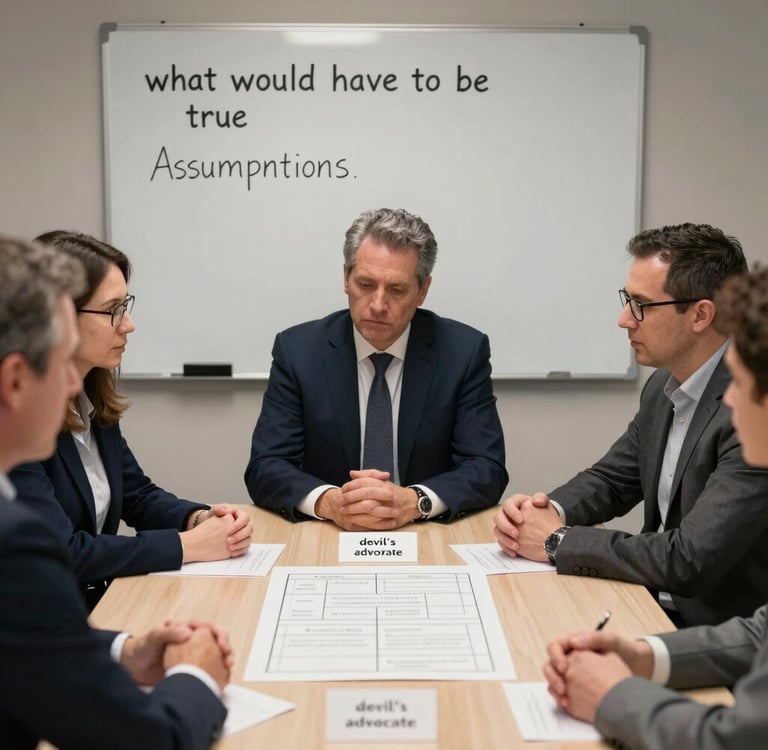
The most powerful single counter to confirmation bias is structural: before any significant decision, explicitly require the team to articulate the strongest case against it and the evidence that would prove it wrong. Assigning someone the formal role of devil's advocate — responsible for arguing the opposing position regardless of personal view — converts the search for disconfirming evidence from a personal virtue into a process requirement. This is the discipline that the evenhanded analysis of any major decision demands.
2 Decide against pre-defined criteria, not in the moment
Defining the decision criteria before evaluating the options — what would make a candidate a yes, what return threshold justifies the investment, what conditions would trigger ending the initiative — prevents the in-the-moment rationalization that bias thrives on. The hiring scorecard of Post 31, the KPI thresholds of Post 4, and the pre-defined exit conditions for projects in Post 33 are all expressions of this principle: decide the standard before the emotion of the specific situation can bend it.
3 Ground decisions in data, not impression
As established in Post 15 of this series, data-driven organizations significantly outperform intuition-led ones. The connection to bias is direct: data is the most reliable counter to the impressions, anecdotes, and gut feelings that bias distorts. The leader who reviews the actual retention numbers is less vulnerable to recency bias than the one reacting to the last customer who complained. Structured evidence is bias's most consistent antidote — which is why the KPI dashboards and data disciplines covered throughout this series are also decision-quality investments.
4 Use collective decision-making for high-stakes calls
The 2025 SAGE research on managers' cognitive biases found that well-structured collective decision-making — drawing on diverse perspectives, including from people not directly invested in the outcome — measurably reduces individual bias. The caution: groups have their own biases, including groupthink and herd behavior, which must be managed through structured processes that genuinely surface dissent rather than suppress it. A diverse group with a disciplined process makes better decisions than even a skilled individual deciding alone.
Judgment as a Manageable System
The most valuable reframe the bias research offers business leaders is this: decision quality is not a fixed trait of individual judgment. It is a manageable system. The same leader, making the same decision, will reach a better outcome with a structured process that surfaces disconfirming evidence and grounds the choice in data than with an unstructured one that runs on intuition and confidence. The biases never disappear — they are permanent features of how human minds work. But their influence on business outcomes can be substantially reduced through the deliberate design of how decisions get made.
For a small business, where a handful of major decisions each year can determine the trajectory of the entire enterprise, the return on building better decision processes is among the highest available anywhere in the operation. The cost is modest: a few structural habits applied to the decisions that matter most. The benefit is a measurably higher hit rate on exactly the choices that shape the future of the business.
Contact
Let's improve your business together.
contact@rmscsolutions.com
© 2026 All rights reserved.
Contact
+1 647-576-7000