The $375 Billion Problem in Your Calendar
CONTINUOUS IMPROVEMENTOPERATIONAL EFFECTIVENESSPERFORMANCE IMPROVEMENT
5/2/2026
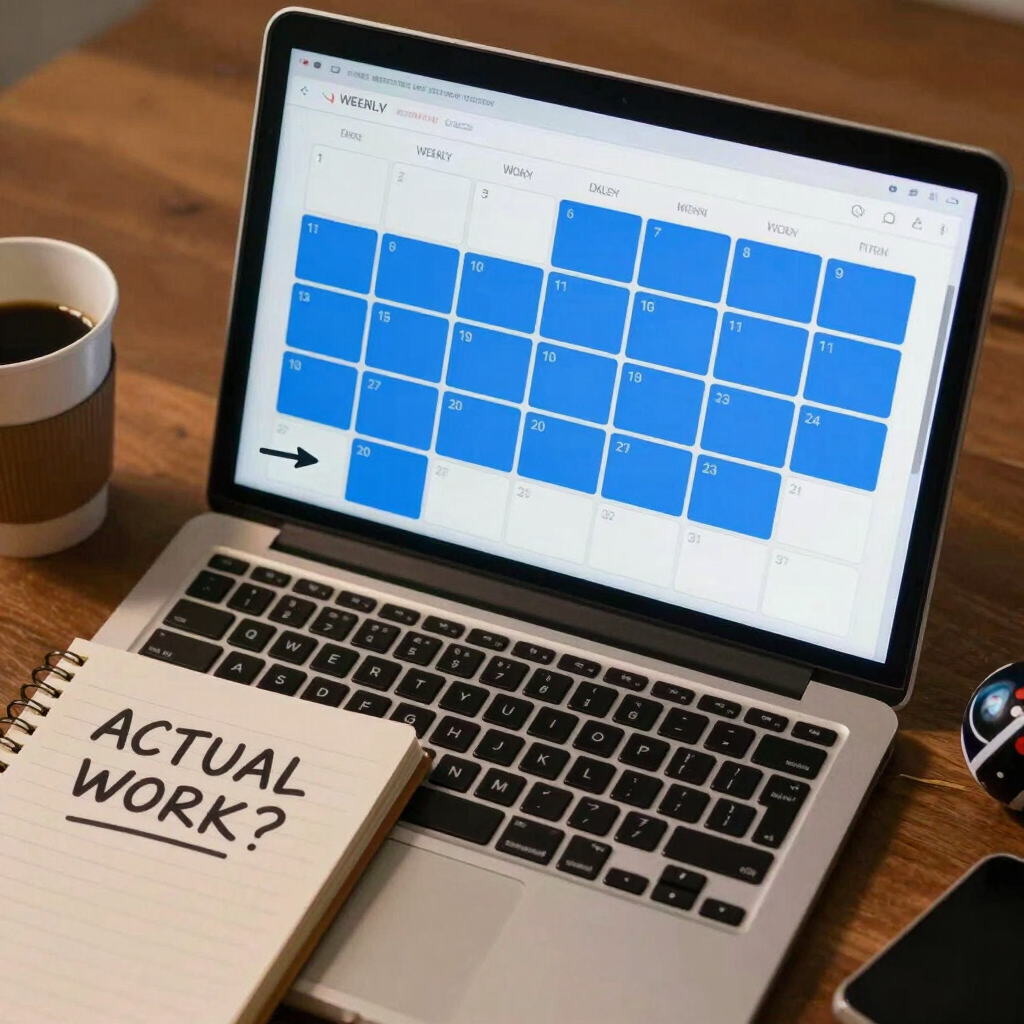
Open any senior leader's calendar on a given Tuesday, and you will find the most expensive resource in your business — executive judgment and focused time — allocated to recurring check-ins, status updates, alignment calls, and information-sharing sessions that, by the end of the hour, have produced nothing that couldn't have been achieved by a well-written email or a structured weekly report.
This is not a minor inefficiency. It is a systemic organizational problem with a quantified cost — and it compounds daily across every level of the business.
Unproductive meetings cost U.S. businesses upwards of $375 billion annually, according to research aggregated across Atlassian, Harvard Business Review, and Bloomberg. The average employee loses 31 hours per month in unproductive meetings — nearly four full working days. And the people who feel it most acutely are the ones whose time is most valuable: 71% of managers report that most meetings are a waste of time, while the average CEO spends up to 72% of their working hours in meetings, leaving less than 30% for the strategic work that only they can do.
$375B+ annual cost of unproductive meetings to U.S. businesses — equivalent to four lost working days per employee every month
Atlassian / Harvard Business Review / Bloomberg Research
Why the Meeting Problem Is Actually a Systems Problem
The persistent intuition is that bad meetings are a people problem — the wrong attendees, the wrong facilitators, the wrong culture. The research consistently contradicts this framing. Flowtrace's analysis of 2.2 million real meetings across 2024–2025 found that the root causes are structural: 64% of recurring meetings lack a clear agenda, half of meetings start late, and 29% of recurring meetings pull in seven or more people — far beyond the number who can contribute meaningfully.
71% of managers consider most meetings to be a waste of time — yet meeting culture persists unchanged
Various / JoinGenius Research, 2025
78% of professionals say they attend so many meetings it is hard to get real work done
Atlassian Research
63% of meetings are conducted without a predefined agenda — the single most cited cause of unproductive sessions
Atlassian, cited in Flowtrace, 2025
90% of employees experience a productivity "meeting hangover" after days overloaded with back-to-back meetings
Flowtrace Unproductive Meeting Research, 2026
The meeting hangover statistic is worth dwelling on. The cost of a bad meeting is not confined to the time the meeting consumes. Research shows that 76% of workers feel exhausted on heavy meeting days — and that exhaustion carries into the hours that follow. Context switching, reduced concentration, and the mental fatigue of sustained social interaction each reduce the quality of independent work done in the same day. The calendar cost and the cognitive cost compound.
The Three Types of Meetings That Drain the Most Value
1 The recurring meeting that outlived its purpose
Atlassian's research found that up to 50% of recurring meetings are unnecessary or could be handled via alternative means. The weekly team check-in that was set up during a crisis. The monthly business review that no one has reframed since the business changed. These meetings continue because cancelling them requires a decision that no one has made — not because they are delivering value. A quarterly audit of every recurring meeting — with the default being cancellation unless a clear case is made for continuation — is one of the highest-leverage calendar reforms available to any leadership team.
2 The information-sharing meeting that should have been a document
A large proportion of meetings exist to share information that one person has and others need. This is a legitimate need — but it is almost never best served by gathering eight people in a room for an hour. Well-structured written updates, shared dashboards, and asynchronous video briefings deliver the same information with a fraction of the collective time cost, and have the added benefit of being searchable and referenceable later. Sixty-eight percent of workers say frequent meetings prevent them from doing their best work — and a significant portion of those meetings are one-directional information transfers that no one present was required to attend.
3 The bloated decision meeting with no owner
Sixty-one percent of C-suite executives attribute unproductive meetings to a lack of clear objectives — and 51% specifically cite meetings that are irrelevant to key participants. When a decision meeting invites every stakeholder who might conceivably have an opinion, rather than the two or three people with the authority and information to make the call, the meeting doesn't converge on a decision. It converges on a discussion — after which everyone leaves with a different understanding of what was decided, who is responsible, and what happens next. Flowtrace found that companies that deliberately cut average meeting size by 27% saw dramatic improvements in decision speed and clarity.
What a High-Quality Meeting Culture Actually Looks Like
The organizations that run meetings well don't do so through motivation or meeting etiquette training. They do so through structural discipline applied consistently. The research identifies a clear set of practices that distinguish high-meeting-quality organizations from those where the calendar is the enemy of execution.
What works
Clear written agenda distributed before the meeting, minimum 24 hours in advance
Named decision-maker or meeting owner for every session
Explicit desired outcome stated at the start: decision, alignment, or information
Participant list limited to those who are essential — not those who might be interested
Action items with named owners and deadlines documented before the call ends
Regular audit of recurring meetings with a bias toward cancellation
What doesn't
Recurring meetings with no defined purpose or outcome criteria
Default 60-minute blocks because that's what the calendar suggests
Seven-plus-person calls where two people do 90% of the talking
Updates and information sharing that could be a written document
Meetings that end without clear decisions, owners, or next steps
Meeting culture driven by availability rather than necessity
The Compounding Value of Reclaimed Focus Time
The reason meeting reform matters beyond simple time savings is what happens in the time reclaimed. Research consistently shows that deep, uninterrupted work — the kind that produces strategy, solves complex problems, and develops people — requires sustained focus blocks of 90 minutes or more. The average professional's calendar, fragmented by back-to-back meetings and frequent interruptions, rarely produces these blocks. Sixty-eight percent of workers say they don't have enough uninterrupted focus time in their workday because of meetings and communication overhead.
"80% of people say fewer meetings would make them more productive. The problem is not that teams disagree — it is that no one has given themselves permission to change it."
— Atlassian / Flowtrace Unproductive Meeting Research, 2025–2026
For small business leaders, the calculus is particularly stark. If a CEO or COO is spending 50–70% of their workday in meetings — as the research suggests is common for senior leaders — the hours available for strategic work, talent development, and the high-leverage decisions that determine the company's direction are being systematically crowded out by coordination overhead that a better-designed operating rhythm would eliminate.
Flowtrace's data from companies that deliberately reformed their meeting culture is instructive: by reducing meeting size by 27% and eliminating a portion of low-value recurring sessions, these organizations saved the equivalent of one full-time employee day per 100 meetings — freeing meaningful blocks of focus time across their leadership and execution teams. That is not a marginal gain. It is structural capacity recovered.
The One Change That Creates the Most Leverage
If there is a single discipline that consistently separates high-performing meeting cultures from those still mired in calendar overload, it is the weekly operational review — a short, structured, outcome-focused session that replaces the scattered ad-hoc check-ins, status updates, and alignment calls that currently consume most of the week.
A well-designed 45-minute weekly review covers the right KPIs, surfaces blockers that need leadership attention, confirms ownership of ongoing initiatives, and makes the two or three decisions that need to be made. When this rhythm is working, it functions as a pressure release valve: because leadership knows the next structured forum for operational issues is four days away, the urgency to schedule additional meetings dissolves. The calendar clears. And the work that actually drives the business forward gets the focused time it requires.
Contact
Let's improve your business together.
contact@rmscsolutions.com
© 2026 All rights reserved.
Contact
+1 647-576-7000