
If You Can't See It, You Can't Improve It: The Case for KPI Dashboards in Small Business
DATA & INSIGHTSPERFORMANCE IMPROVEMENT
4/22/2026
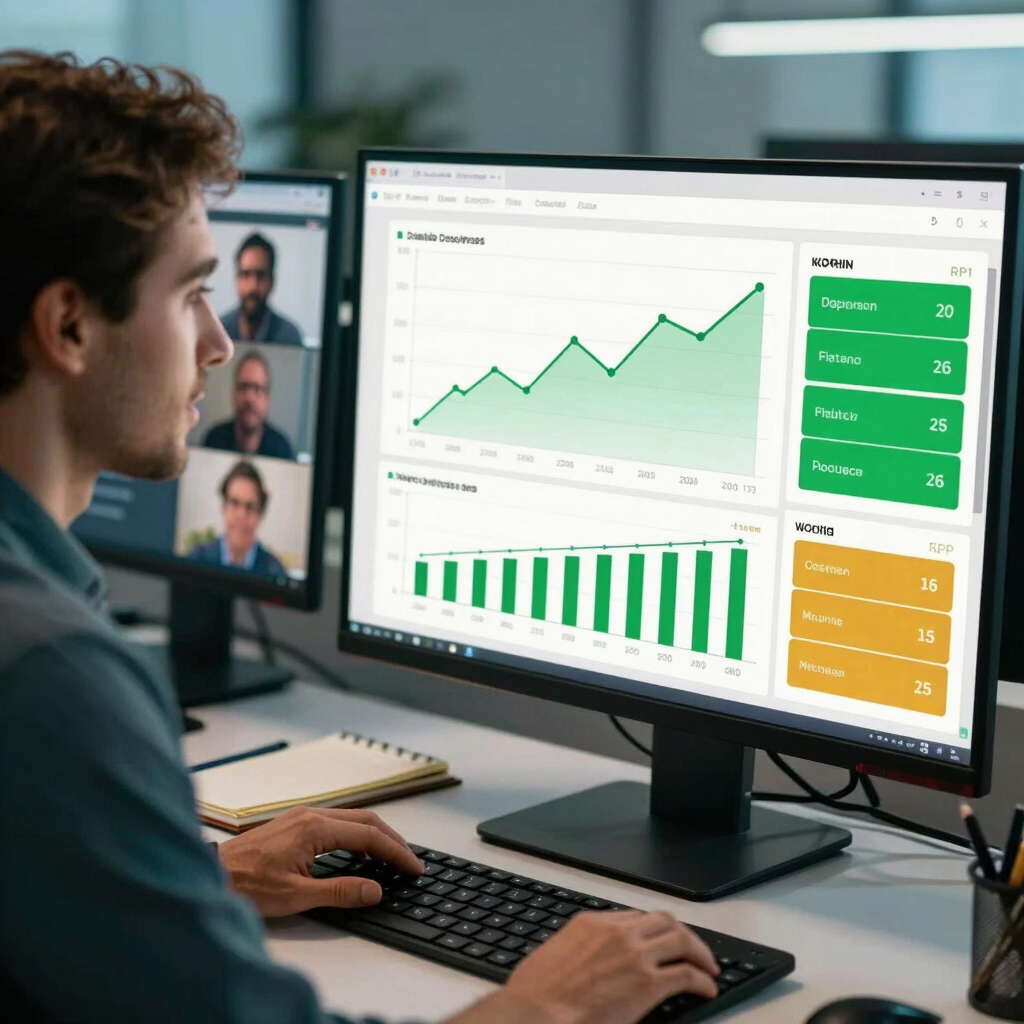
Every week, thousands of small business owners make decisions — on hiring, pricing, marketing spend, operations changes — based on a combination of instinct, outdated spreadsheets, and the rough sense that things feel about right. Some of the time, they're correct. Most of the time, they're leaving margin on the table that a simple, focused KPI dashboard would have recovered.
The numbers on what visibility actually does to business performance are striking — and largely unavailable to the SMB leaders who need them most, because the research tends to live in enterprise circles.
5× more likely to be top financial performers — companies that embed data-driven decision-making cultures
McKinsey & Company
That five-times differential is not the product of sophisticated analytics infrastructure that only enterprise companies can afford. It is the product of a discipline: knowing which five to seven numbers actually drive your business, making them visible to the people responsible for moving them, and reviewing them on a cadence that allows for course correction before a problem becomes a crisis.
The Problem with Gut-Feel Management
Gut feel is not useless. Experienced operators have genuine pattern recognition built from years of close contact with their business. But gut feel has a fatal flaw: it is backwards-looking, slow to update, and deeply vulnerable to recency bias. The quarter that felt great can still hide a deteriorating cost structure. The month that felt hard can mask a customer cohort with unusually high lifetime value that just hasn't shown up in revenue yet.
A Harvard Business Review study found that companies leveraging data-driven decision-making are 5% more productive and 6% more profitable than their competitors — on the same inputs, the same markets, the same competitive dynamics. The only differentiator is the quality and speed of the decisions being made. Real-time KPI tracking, per the same body of research, reduces decision-making time by 25% and boosts team productivity by 15–20%.
30% increase in employee productivity from companies adopting real-time KPI tracking systems
Vorecol / Psico Smart, 2024
25% reduction in decision-making time with real-time performance data in place
Harvard Business Review, 2024
15% average annual revenue growth for organizations using real-time data analytics
Psico Smart / McKinsey, 2026
3× more likely to establish long-term performance habits — teams with a centralized dashboard vs. isolated metrics
SimpleKPI Research, 2025
What Most Small Businesses Are Actually Tracking (and Why It's Not Working)
The most common measurement failure in small business is not the absence of data — it's the abundance of the wrong data. Revenue. Expenses. Hours logged. Calls made. Units shipped. These are input and activity metrics: they confirm that the business is moving, but they say almost nothing about whether the movement is in the right direction, or whether it will produce the outcomes the business needs.
Outcome metrics — the numbers that answer "are we actually getting better?" — are what make the difference. Customer acquisition cost by channel. Gross margin by product line. Revenue per employee. Customer churn rate. Cycle time from lead to close. Defect or rework rate. Average time to resolution on support issues.
"A dashboard that tries to show everything shows nothing. Effective dashboards are focused, actionable, and audience-specific."
— Devimus Analytics & KPI Guide, 2026
The research backs this counterintuitively narrow approach. SimpleKPI's analysis of thousands of businesses found that teams successfully using a centralized dashboard — tracking a focused set of relevant metrics — are nearly three times more likely to establish long-term performance tracking habits compared to those managing isolated metrics across spreadsheets and disparate reports. The discipline builds on itself.
Building a KPI Dashboard That Actually Gets Used
The graveyard of business improvement initiatives is littered with dashboards that were built, celebrated, and abandoned within ninety days. The reason is almost always the same: the dashboard was built to report, not to decide. It answered the question "what happened?" rather than "what do we do next?"
A dashboard that drives behavior has three design principles behind it:
1 It measures outcomes, not inputs
Every metric on the dashboard should directly answer: "Is the business improving in ways that matter?" If a metric can be high while the business is deteriorating, it belongs off the dashboard.
2 It has an owner for every number
A KPI without a named owner is just a data point. Each metric on the dashboard should belong to a specific person who is accountable for understanding why it moved and what they're doing about it.
3 It is reviewed on a regular cadence that creates accountability
McKinsey's data shows that organizations embedding data-driven cultures — where review and response are part of the weekly rhythm, not a quarterly event — are the ones generating the 5× performance differential. Visibility without cadence is decoration.
The SMB Opportunity
Large enterprises have entire data analytics teams. They have BI platforms, data warehouses, and dedicated dashboarding functions. But they also have the organizational complexity that slows response to what the data is showing. A small or midsize business with five to seven well-chosen KPIs — reviewed weekly by a leadership team of three or four people who can actually make decisions — can respond to what the data reveals faster than any enterprise competitor.
The 2024 research from the Association of Chartered Certified Accountants found that well-designed KPI dashboards showing live performance metrics can noticeably improve both the speed and quality of management decisions by providing concise, up-to-the-minute insight. The technology required to build this today — for a business of any size — is inexpensive, accessible, and faster to deploy than most leaders realize.
The question is not whether you can afford to have a KPI dashboard. It is whether you can afford to keep making decisions without one.
Contact
Let's improve your business together.
contact@rmscsolutions.com
© 2026 All rights reserved.
Contact
+1 647-576-7000